
Current Temperature

 Log In
Alberta quietly strips habitat protections from endangered Greater Sage-Grouse
Posted on November 6, 2026 by Ryan Dahlman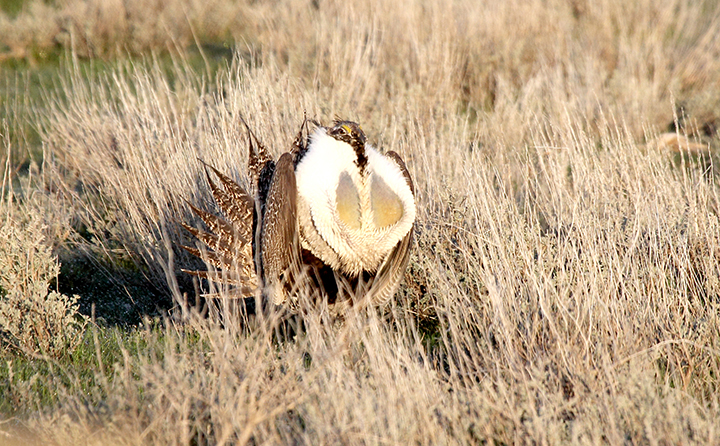 Courier/Commentator Photo Courtesy of Dominic Sherony, CC BY-SA 2.0, via Wikimedia Commons.
By Nerissa McNaughton
Southern Alberta Newspapers
Alberta quietly lifted habitat protections across 2,800 km² of Greater Sage-Grouse range. Here’s what changed, what’s at stake, and how residents can respond.
In July 2026, the Government of Alberta removed provincial habitat protections covering roughly 2,800 square kilometres, or 74 per cent, of Greater Sage-Grouse range, without public consultation or an official announcement. With fewer than 100 birds left in the province, conservationists warn the changes threaten to extirpate the species from Canada.
The Greater Sage-Grouse (Centrocercus urophasianus urophasianus) is the largest North American grouse species, and it depends heavily on silver sagebrush grassland in southeastern Alberta for food, shelter, and breeding. The bird is listed as endangered under both the federal Species at Risk Act (SARA) and Alberta’s Wildlife Act, and its decline has been steep. Alberta’s Greater Sage-Grouse population numbered in the thousands as recently as the 1960s, but today, fewer than 100 individuals remain in the province. The most recent publicly available census, conducted by the Government of Alberta in 2023, estimated as few as 54 birds. Because habitat loss and fragmentation have already confined the species to less than 10 per cent of its historical range, Alberta’s population is considered one of the last remaining in Canada, and its loss would represent a significant setback for the species nationally.
What changed in Alberta’s habitat protections, and when?
In July 2026, the Government of Alberta amended the Public Lands Act in a way that removed provincial habitat protections from approximately 2,800 square kilometres of previously protected Greater Sage-Grouse territory, or about 74 per cent of the roughly 3,800 square kilometres that had been covered. The removed conditions had restricted activities such as new road construction, noise above 45 decibels during sensitive seasons, structures taller than 1.2 metres, and disturbance of sagebrush within core and recovery areas, protections that had complemented a federal Emergency Protection Order in place since 2014 under Section 80 of SARA. Only the area still covered by that federal order retains protection today.
According to Joshua Killeen, Conservation Science and Programs Manager at CPAWS Southern Alberta, “The Government of Alberta has removed all of these habitat protections,” which puts “the Greater Sage-Grouse population at risk of being lost completely.”
Killeen notes, “Our understanding is that there’s been significant lobbying by helium extraction companies” seeking to operate within Greater Sage-Grouse range. Notably, the changes were not announced publicly. Instead, CPAWS Southern Alberta learned of them through administrative updates to government websites and documents. “These changes are really significant for the species, and they’ve been made without any public consultation and without even any announcements,” Killeen adds.
What happens now?
Projects that were previously prohibited or tightly restricted within Core and Recovery Areas can now proceed. The Alberta Energy Regulator has already approved construction of a small plant site by helium extraction company Thor Resources within what had been a provincially identified Recovery Area, a decision issued without the Greater Sage-Grouse conditions that would previously have applied.
Future helium development in the region would likely require new well sites, processing facilities, vertical infrastructure, and roads, all development types that the removed conditions had been designed to limit, and all are associated with the noise and habitat disturbance that most threaten the species.
Killeen noted that the policy shift runs counter to years of provincial investment in recovery efforts. The changes, he said, are “in direct conflict with everything that the Government of Alberta has done over the past decade-plus in this region.”
IHas the Government of Alberta responded to concerns about the policy change?
As of this writing, there is no indication that the province intends to reverse the amendments or otherwise address the concerns raised by conservation organizations. CPAWS Southern Alberta has reached out directly to Grant Hunter, Minister of Environment and Protected Areas, but there has been no response.
What can you do?
Conservation groups are encouraging public engagement while the issue remains unresolved. Residents can:
• Contact the Minister of Environment and Protected Areas to express concern about the removal of habitat protections.
• Reach out to their local MLA to voice opposition to the changes.
• Support conservation organizations, such as CPAWS Southern Alberta, that are working to protect the species.
• Stay informed as developments unfold, since the changes were made without formal announcement and further updates may similarly go unpublicized.
A critical moment for one of Canada’s most endangered birds
Alberta’s decision to remove Greater Sage-Grouse habitat protections marks a significant reversal for a species that has depended on sustained conservation investment just to survive at current numbers. The manner in which the changes were made, through administrative updates rather than public process, has raised questions among conservation groups about transparency in provincial environmental decision-making.
With fewer than 100 birds remaining and no indication yet that the province will revisit the amendments, public pressure may be one of the few remaining avenues to influence the outcome.
For a population that has held on for two decades through deliberate, costly intervention, the coming months could determine whether the Greater Sage-Grouse remains part of Alberta’s landscape at all.
Leave a Reply
You must be logged in to post a comment.