
Current Temperature

 Log In
Southern Alberta’s long-term forecast: what it means for agriculture
Posted on March 12, 2026 by Ryan Dahlman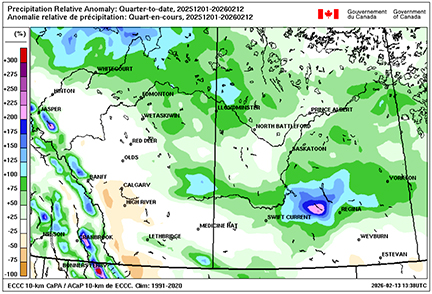 Commentator/Courier Image Courtesy of Government of Canada
By Nerissa McNaughton
Southern Alberta Newspapers
Southern Alberta’s agricultural industry is bracing for a challenging year ahead as meteorological forecasts and drought conditions paint a mixed picture for the region. While December brought above-normal precipitation and some drought relief, the long-term outlook suggests a return to drier conditions, leaving farmers and ranchers to navigate an uncertain growing season.
Alyssa Peterson, a meteorologist with Environment Canada, shared insights into the seasonal forecast for southern Alberta.
“For spring—March, April, and May—we’re seeing indications of above-normal temperatures, which often correlate with drier-than-normal conditions,” Peterson explains. “This is due to a weather pattern called an upper ridge, which tends to push storm systems north of our region.”
Peterson emphasized the critical role of spring precipitation in shaping the agricultural landscape.
“Southern Alberta relies heavily on spring rains, particularly in April, May, and June, when we typically see significant low-pressure systems that can bring substantial moisture. These spring rains are pivotal in determining whether the summer will be dry or more favorable for agriculture.”
December 2025’s weather brought some relief to drier across the Prairies, including southern Alberta. According to the Canadian Drought Monitor, above-normal precipitation and colder-than-normal temperatures contributed to moderate drought improvement. In southern Alberta, reductions in Abnormally Dry (D0) and Moderate Drought (D1) conditions were observed, though pockets of Moderate Drought persist near Medicine Hat and south of Lethbridge along the Alberta–U.S. border.
“December’s snowfall was significant, with some areas receiving more than three times their normal monthly totals,” Peterson noted. “However, January was exceptionally dry, with Medicine Hat recording just 3.8 mm of precipitation—below the January average of 13.8 mm.”
Despite the temporary improvements in December, the long-term forecast suggests a return to drier conditions for southern Alberta. Peterson cautioned that while seasonal forecasts provide a broad picture, they can’t account for localized weather events.
“A couple of big storms in the spring could change the outlook entirely, but as of now, we’re expecting normal to drier than normal conditions for much of the region.”
The Canadian Drought Monitor underscores the ongoing challenges, with 79 per cent of the Prairie Region classified as Abnormally Dry (D0) or in Moderate (D1) to Extreme Drought (D3) at the end of December. This includes 62 per cent of the region’s agricultural landscape.
For southern Alberta’s farmers and ranchers, the forecast means planning and adaptation will be necessary. Spring rains will be the deciding factor in whether crops and pastures will thrive or if drought conditions will persist. Peterson also pointed out the complexities of drought recovery, noting that even significant rainfall may not immediately translate to improved soil moisture due to runoff and other factors.
As the region looks ahead to the growing season, the agricultural community will be keeping a close eye on weather patterns and hoping for those critical spring rains. In the meantime, the Canadian Drought Monitor remains a valuable resource for tracking conditions and planning for the months ahead.
For more detailed information on drought conditions, visit Agriculture and Agri-Food Canada’s Canadian Drought Monitor online.
Leave a Reply
You must be logged in to post a comment.