
Current Temperature

 Log In
Alberta stepping up enforcement of invasive mussel defence
Posted on May 7, 2026 by Ryan Dahlman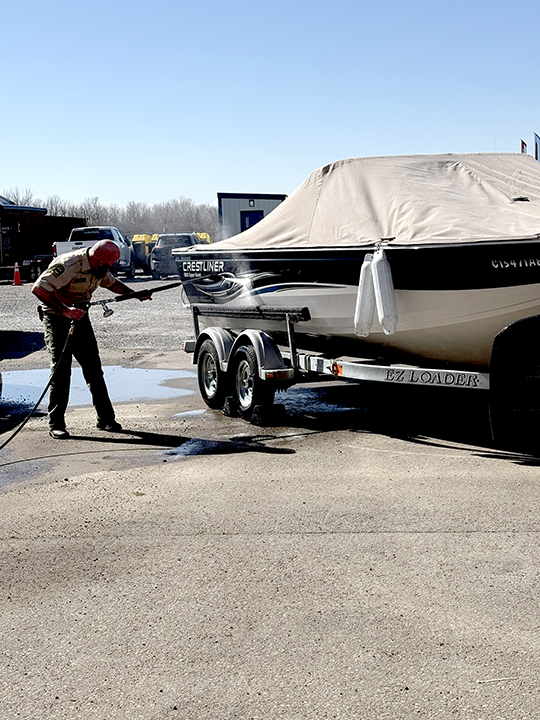 Commentator/Courier Photo by Alexandra Noad. ENFORCEMENT: The Government of Alberta is taking precautions to protect waterways from invasive mussel such as quagga mussels (in picture) which latch onto hard surfaces such as ABS pipe in irrigation canals. All boats entering the province from the south and east borders are required to be inspected within seven days and before entering Alberta waters in an effort to prevent invasive mussels from entering the province.
 By Alexandra Noad
Southern Alberta Newspapers
Local Journalism Initiative Reporter
Boating season is quickly approaching and Alberta’s government is strengthening its defences against invasive mussel species to protect lakes, rivers and critical infrastructure.
Invasive mussels including quagga, zebra and golden mussels destroy ecosystems, threaten shorelines and can cause hundreds of millions of dollars in damage. One female mussel can open up and release one million eggs, which can quickly lead to an infestation.
These mussels also attach themselves on hard surfaces and rapidly accumulate in layers to the point where they can begin clogging things like the intakes to irrigation pipelines, intakes to the canals and the reservoirs.
If mussels were to invade irrigation canals, Richard Phillips, chair of Alberta Irrigation Districts Association says it would have devastating consequences on the farmers and municipalities who rely on irrigation water.
“If our reservoirs, canals and pipelines were to be impacted by invasive mussels, the increased annual cost to keep water pulling for all of these uses to keep water pulling for all of these uses would be enormous and there would be irreparable damage to them.”
There are currently zero known cases of invasive mussels in British Columbia, Alberta and Saskatchewan.
Due to the cost of just managing invasive mussels, Grant Hunter, Minister of Environment and Protected Areas, says prevention is the provinces highest priority.
“If you take a look at what’s happening in Ontario, the cost to just maintain what they have for the water intakes for communities is in the hundreds of millions of dollars, so that’s the reason why we’re being very careful.”
To protect Alberta waterways, from May 1 until Sept. 30, all motorized and non-motorized watercraft entering the province from the eastern and southern boarders will be required to mandatory inspections at an inspection station. If the nearest inspection station is closed, Albertans and visitors must get their watercraft inspected within seven days of entering the province and before launching into Alberta’s waters.
Failure to have watercraft inspected would result in a fine of $4,200, the highest in North America.
Last year, 21,995 boats were inspected, with 13 of them found carrying invasive mussels-all who attempted to cross from the eastern provinces or the U.S.
This year, 12 inspections stations will be open, the most ever operated by the program. This includes a new inspection station located at the Chief Mountain Border crossing in Waterton Lakes National Park, in collaboration with Parks Canada and Canada Border Services.
Conservation K-9s and watercraft inspections work together to detect invasive mussels at strategic entry points across Alberta, which is why the K-9 unit is expanding from one to three teams to support detection of invasive mussels in about half the time it takes human inspectors.
Through Budget 2026, an investment of $5 million over two years is being made for a permanent roadside watercraft inspection station near Cold Lake. The new inspection Station will improve compliance in the Cold Lake region and those crossing through the Alberta-Saskatchewan border.
More information on how you can do your part in protecting Alberta’s ecosystem can be found at www.alberta.ca/clean-drain-dry-your-gear.
Leave a Reply
You must be logged in to post a comment.